The Eukaryote Linear Motif resource for Functional Sites in Proteins
 
 << LIG_WW_3 <<  Menu  >> MOD_ASX_betaOH_EGF >> 
 
Functional site class: WW domain ligands
Functional site description: WW Domains are small but abundant domains found in diverse regulatory situations. The binding peptide motifs appear always to involve proline residues. Specific motifs vary for different WW domains and in some cases must be phosphorylated on a serine or threonine.
ELMs: LIG_WW_1 LIG_WW_2 LIG_WW_3 LIG_WW_Pin1_4
Description: Proline-directed phosphorylation is a major cellular signalling mechanism. Proline directed kinases include Map kinases and cyclin-dependent kinases. Many p(S/T)P sites act as binding motifs for recruiting proteins or placing enzymes close to their substrates. Proline isomerisation may confound the function of these sites but also provides a mechanism for their regulation. This requires a peptidyl-prolyl cis/trans isomerase (PPIase). The phospho-specific PPIase is Pin1 (for Protein interacting with NIMA 1). It belongs to the parvulin subfamily of PPIases. Pin1 homologs are highly conserved in eukaryotes. Pin1 regulates diverse cellular process, including growth-signal response, cell-cycle progression, cellular stress response, neuronal function and immune response.

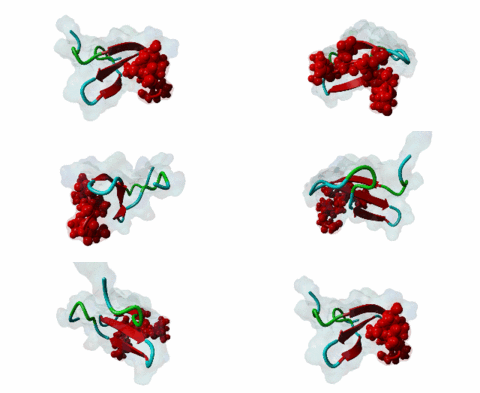
Pin1 is an 18 kDa protein with two domains: the N-terminal WW domain and the C-terminal PPIase domain connected by a flexible linker. The WW domain acts as the binding module to bind its substrate p(S/T)P site and bring the catalytic PPIase domain close to its substrate where it catalyses cis-trans conversions. The Pin1 WW domain interaction with substrates occurs through a conserved phosphate-binding pocket, present in Pin1 and it homologues. The pSer/Thr-Pro peptides all bind to the WW domain in the trans conformation. Only WW domains which have an arginine in loop1 will be able to bind the sequence with core motif p(S/T)P. The phosphorylated residue is recognized by the Arginine as well as by backbone interactions. The Pro residue enters a pocket bounded by the second Tryptophan.
Pattern: ...([ST])P. (Probability: 0.0154332)
Present in taxons: Eukaryota Homo sapiens Saccharomyces cerevisiae
Interaction Domain:

WW (PF00397)
WW domain
(Stochiometry: 1 : 1)

o See 96 Instances for LIG_WW_Pin1_4


o Abstract

WW are small modular domains of 38-40 residues long that mediate protein-protein interaction through binding of short proline-containing peptides that are typically in regions of native disordered polypeptide. WW are named after a pair of tryptophan residues that are important for structure-function. WW domains can occur singly or in clusters of up to four, as in the ubiquitin ligase Nedd4. WW domain-containing proteins are involved in many cellular processes such as ubiquitin-mediated protein degradation and mitotic regulation and they are also implicated directly or indirectly in several human diseases such as muscular distrophy and Alzheimer's and Huntington's diseases. Based on their ligand specificities, the WW domains have been divided into four classes. Group I WW domains bind proteins containing the PPXY motif, while group II recognize the PPLP motif. Group III recognise PPR motifs. There may be some overlap between the group II and III specificities. Group IV recognition is of p(ST)P sites and is dependent on phosphorylation by proline-directed kinases.


The peptidyl-prolyl cis/trans isomerases (PPIase) are evolutionarily conserved enzymes that catalyse the cis/trans isomerization of peptidyl-prolyl peptide bonds. Pin1 is a unique PPIase that recognizes only the phosphorylated S/T motif preceding a proline residue. It is a multidomain protein contains a WW domain and PPIase domain and both domains work together to target the p(S/T)P sequence. Pin1 acts a mitotic regulator by catalyzing the isomerization of p(S/T)P motifs present in a defined subset of mitosis-specific phosphoproteins and also plays essential roles in transcription, DNA damage response, neuronal survival etc. The consequence of Pin1-mediated isomerization varies in individual substrates and phosphorylation sites which make them amenable to different processes like dephosphorylation, protein degradation, cleavage and targeting to different sub cellular localization etc. It is also found that the aberrant function of pin1 is linked to many diseases like cancer, AD, asthma, ageing and microbial infection and thus it represents a major therapeutic target.

o 15 selected references:

o 11 GO-Terms:

o 96 Instances for LIG_WW_Pin1_4
(click table headers for sorting)
SequenceStartEndSubsequence
Instance LogicPDB Organism
CEP55_MOUSE 420 425 REPESRVKATSPKSPSAALN true positive --- Mus musculus (House mouse)
SNCAP_HUMAN 208 213 SSNMAPFCVLSPVKSPHLRK true positive --- Homo sapiens (Human)
NANOG_MOUSE 49 54 ATEMLCTEAASPRPSSEDLP true positive --- Mus musculus (House mouse)
NANOG_MOUSE 62 67 PSSEDLPLQGSPDSSTSPKQ true positive --- Mus musculus (House mouse)
SPT23_YEAST 651 656 IAKRIVGSDSSPSNNNAGLH true positive --- Saccharomyces cerevisiae S288c
P53_HUMAN 30 35 WKLLPENNVLSPLPSQAMDD true positive --- Homo sapiens (Human)
SNCAP_HUMAN 212 217 APFCVLSPVKSPHLRKASAV true positive --- Homo sapiens (Human)
P73_HUMAN 409 414 LQPPSYGPVLSPMNKVHGGM true positive --- Homo sapiens (Human)
P73_HUMAN 439 444 GQPPPHSSAATPNLGPVGPG true positive --- Homo sapiens (Human)
P73_HUMAN 479 484 AQSMVSGSHCTPPPPYHADP true positive --- Homo sapiens (Human)
CDN1B_HUMAN 184 189 GSPNAGSVEQTPKKPGLRRR true positive --- Homo sapiens (Human)
CCND1_MOUSE 283 288 EVEEEAGLACTPTDVRDVDI true positive --- Mus musculus (House mouse)
CTNB1_HUMAN 243 248 GIPALVKMLGSPVDSVLFYA true positive --- Homo sapiens (Human)
JUN_HUMAN 60 65 LRAKNSDLLTSPDVGLLKLA true positive --- Homo sapiens (Human)
MYC_HUMAN 55 60 DIWKKFELLPTPPLSPSRRS true positive --- Homo sapiens (Human)
PML_HUMAN 400 405 GKDAAVSKKASPEAASTPRD true positive --- Homo sapiens (Human)
PML_HUMAN 524 529 VSPPHLDGPPSPRSPVIGSE true positive --- Homo sapiens (Human)
SMAD3_HUMAN 201 206 HQMNHSMDAGSPNLSPNPMS true positive --- Homo sapiens (Human)
ST4A1_HUMAN 8 13 MAESEAETPSTPGEFESKYF true positive --- Homo sapiens (Human)
TFCP2_MOUSE 288 293 PEITYVNNSPSPGFNSSHSS true positive --- Mus musculus (House mouse)
NR4A1_HUMAN 137 142 DYYGSPCSAPSPSTPSFQPP true positive --- Homo sapiens (Human)
GEPH_MOUSE 185 190 EVHDELEDLPSPPPPLSPPP true positive --- Mus musculus (House mouse)
NOTC1_HUMAN 2129 2134 PQLHGAPLGGTPTLSPPLCS true positive --- Homo sapiens (Human)
JUN_HUMAN 70 75 SPDVGLLKLASPELERLIIQ true positive --- Homo sapiens (Human)
NONO_MOUSE 409 414 AMPPAPVPPGTPAPPGPATM true positive --- Mus musculus (House mouse)
NONO_MOUSE 427 432 TMMPDGTLGLTPPTTERFGQ true positive --- Mus musculus (House mouse)
NONO_MOUSE 449 454 TMEGIGAIGGTPPAFNRPAP true positive --- Mus musculus (House mouse)
PO5F1_HUMAN 9 14 AGHLASDFAFSPPPGGGGDG true positive --- Homo sapiens (Human)
TAX_HTL1A 157 162 SVVCMYLYQLSPPITWPLLP true positive --- Human T-cell lymphotrophic virus type 1 (strain ATK)
FOS_MOUSE 229 234 DLTGGLPEASTPESEEAFTL true positive --- Mus musculus (House mouse)
FOS_MOUSE 322 327 PMVTELEPLCTPVVTCTPGC true positive --- Mus musculus (House mouse)
FOS_MOUSE 328 333 EPLCTPVVTCTPGCTTYTSS true positive --- Mus musculus (House mouse)
FOS_MOUSE 371 376 GSSSNEPSSDSLSSPTLLAL true positive --- Mus musculus (House mouse)
X_HBVA3 38 43 SGPLGTLSSPSPSAVPADHG true positive --- Hepatitis B virus adw2/Rutter/1979
AKT1_HUMAN 89 94 TVIERTFHVETPEEREEWTT true positive --- Homo sapiens (Human)
AKT1_HUMAN 447 452 EEFTAQMITITPPDQDDSME true positive --- Homo sapiens (Human)
SOC1_ARATH 46 51 CDAEVSLIIFSPKGKLYEFA true positive --- Arabidopsis thaliana (Thale cress)
CEP55_MOUSE 423 428 ESRVKATSPKSPSAALNDSL true positive --- Mus musculus (House mouse)
SOC1_ARATH 192 197 ESTGRGDEESSPSSEVETQL true positive --- Arabidopsis thaliana (Thale cress)
CCNE1_MOUSE 382 387 KAILSEQNRISPPPSVVLTP true positive --- Mus musculus (House mouse)
RARA_HUMAN 74 79 SSEEIVPSPPSPPPLPRIYK true positive --- Homo sapiens (Human)
PML_HUMAN 502 507 EGKEARLARSSPEQPRPSTS true positive --- Homo sapiens (Human)
PML_HUMAN 515 520 QPRPSTSKAVSPPHLDGPPS true positive --- Homo sapiens (Human)
AATF_HUMAN 143 148 SKKSRSHSAKTPGFSVQSIS true positive --- Homo sapiens (Human)
TERF1_HUMAN 146 151 DAQFENDERITPLESALMIW true positive --- Homo sapiens (Human)
SMAD3_HUMAN 176 181 GIEPQSNIPETPPPGYLSED true positive 2LB3
Homo sapiens (Human)
SMAD3_HUMAN 210 215 GSPNLSPNPMSPAHNNLDLQ true positive --- Homo sapiens (Human)
SMAD3_HUMAN 205 210 HSMDAGSPNLSPNPMSPAHN true positive --- Homo sapiens (Human)
P53_HUMAN 78 83 PPVAPAPAAPTPAAPAPAPS true positive --- Homo sapiens (Human)
P53_HUMAN 312 317 KRALPNNTSSSPQPKKKPLD true positive --- Homo sapiens (Human)
ARBK1_MOUSE 667 672 RVPKMKNKPRSPVVELSKVP true positive --- Mus musculus (House mouse)
BTK_MOUSE 18 23 LKRSQQKKKTSPLNFKKRLF true positive --- Mus musculus (House mouse)
BTK_MOUSE 112 117 VYDEGPLYVFSPTEELRKRW true positive --- Mus musculus (House mouse)
IRF3_HUMAN 336 341 LITFTEGSGRSPRYALWFCV true positive --- Homo sapiens (Human)
NCOR2_HUMAN 1238 1243 ITYRGSITHGTPADVLYKGT true positive --- Homo sapiens (Human)
NCOR2_HUMAN 1441 1446 HEIPREELRHTPELPLAPRP true positive --- Homo sapiens (Human)
STF1_MOUSE 200 205 IKSEYPEPYASPPQQPGPPY true positive --- Mus musculus (House mouse)
MEF2C_MOUSE 95 100 LRKKGLNGCDSPDPDADDSV true positive --- Mus musculus (House mouse)
ST4A1_HUMAN 5 10 MAESEAETPSTPGEFESKYF true positive --- Homo sapiens (Human)
MEF2C_MOUSE 107 112 DPDADDSVGHSPESEDKYRK true positive --- Mus musculus (House mouse)
FUBP2_HUMAN 178 183 QQDSGCKVQISPDSGGLPER true positive --- Homo sapiens (Human)
FAK1_HUMAN 907 912 EGVKLQPQEISPPPTANLDR true positive --- Homo sapiens (Human)
IRS1_HUMAN 431 436 GFISSDEYGSSPCDFRSSFR true positive --- Homo sapiens (Human)
TFCP2_MOUSE 306 311 SSFSLGEGNGSPNHQPEPPP true positive --- Mus musculus (House mouse)
TFCP2_MOUSE 326 331 PVTDNLLPTTTPQEAQQWLH true positive --- Mus musculus (House mouse)
MYB_MOUSE 525 530 LLKKIKQEVESPTEKSGNFF true positive --- Mus musculus (House mouse)
NCF1_HUMAN 342 347 RRRQARPGPQSPGSPLEEER true positive --- Homo sapiens (Human)
NR4A1_HUMAN 428 433 AEKIPGFAELSPADQDLLLE true positive --- Homo sapiens (Human)
NR4A1_HUMAN 92 97 ASSTSSSSATSPASASFKFE true positive --- Homo sapiens (Human)
STAT3_HUMAN 724 729 TCSNTIDLPMSPRTLDSLMQ true positive --- Homo sapiens (Human)
WEE1B_XENLA 183 188 STPQVNINPFTPDSLEIQSS true positive --- Xenopus laevis (African clawed frog)
GEPH_MOUSE 197 202 PPPLSPPPTTSPHKQTEDKG true positive --- Mus musculus (House mouse)
GEPH_MOUSE 191 196 EDLPSPPPPLSPPPTTSPHK true positive --- Mus musculus (House mouse)
B2L11_MOUSE 62 67 SPQGPLAPPASPGPFATRSP true positive --- Mus musculus (House mouse)
FBX5A_XENLA 7 12 MMCGFASNQSPKKLSSKKSS true positive --- Xenopus laevis (African clawed frog)
NEK6_HUMAN 212 217 HSLVGTPYYMSPERIHENGY true positive --- Homo sapiens (Human)
NEK6_HUMAN 242 247 CLLYEMAALQSPFYGDKMNL true positive --- Homo sapiens (Human)
NOTC1_HUMAN 2118 2123 RLLDEYNLVRSPQLHGAPLG true positive --- Homo sapiens (Human)
CRTC2_MOUSE 133 138 DSSPYSPAYLSPPPESGWRR true positive --- Mus musculus (House mouse)
NOTC1_HUMAN 2133 2138 GAPLGGTPTLSPPLCSPNGY true positive --- Homo sapiens (Human)
BTG2_HUMAN 144 149 CKNQVLLGRSSPSKNYVMAV true positive --- Homo sapiens (Human)
A4_HUMAN 740 745 HGVVEVDAAVTPEERHLSKM true positive --- Homo sapiens (Human)
FAK1_MOUSE 907 912 EGVKLQPQEISPPPTANLDR true positive --- Mus musculus (House mouse)
TF65_HUMAN 251 256 VHRQVAIVFRTPPYADPSLQ true positive --- Homo sapiens (Human)
PPARG_HUMAN 81 86 YQSAIKVEPASPPYYSEKTQ true positive --- Homo sapiens (Human)
AGL24_ARATH 199 204 TTNVSSYDSGTPLEDDSDTS true positive --- Arabidopsis thaliana (Thale cress)
MYC_HUMAN 59 64 KFELLPTPPLSPSRRSGLCS true positive --- Homo sapiens (Human)
PML_HUMAN 406 411 SKKASPEAASTPRDPIDVDL true positive --- Homo sapiens (Human)
PML_HUMAN 527 532 PHLDGPPSPRSPVIGSEVFL true positive --- Homo sapiens (Human)
TAU_HUMAN 228 233 REPKKVAVVRTPPKSPSSAK true positive --- Homo sapiens (Human)
DAXX_HUMAN 175 180 PTNAENTASQSPRTRGSRRQ true positive --- Homo sapiens (Human)
TFCP2_MOUSE 286 291 PWPEITYVNNSPSPGFNSSH true positive --- Mus musculus (House mouse)
NR4A1_HUMAN 140 145 GSPCSAPSPSTPSFQPPQLS true positive --- Homo sapiens (Human)
KI20B_HUMAN 1601 1606 KMAVKHPGCTTPVTVKIPKA true positive --- Homo sapiens (Human)
A4_HUMAN 665 670 HGVVEVDAAVTPEERHLSKM true positive --- Homo sapiens (Human)
FBXW7_HUMAN 202 207 STTGLVPCSATPTTFGDLRA true positive --- Homo sapiens (Human)

Please cite: ELM - the database of eukaryotic linear motifs (PMID:22110040)

ELM data can be downloaded and distributed for non-commercial use according to the ELM Software License Agreement

feedback@elm.eu.org