
| Accession: | |
|---|---|
| Functional site class: | WW domain ligands |
| Functional site description: | WW Domains are small but abundant domains found in diverse regulatory situations. The binding peptide motifs appear always to involve proline residues. Specific motifs vary for different WW domains and in some cases must be phosphorylated on a serine or threonine. |
| ELMs with same func. site: | DOC_WW_Pin1_4 LIG_WW_1 LIG_WW_2 LIG_WW_3 |
| ELM Description: | Proline-directed phosphorylation is a major cellular signalling mechanism. Proline directed kinases include Map kinases and cyclin-dependent kinases. Many p(S/T)P sites act as binding motifs for recruiting proteins or placing enzymes close to their substrates. Proline isomerisation may confound the function of these sites but also provides a mechanism for their regulation. This requires a peptidyl-prolyl cis/trans isomerase (PPIase). The phospho-specific PPIase is Pin1 (for Protein interacting with NIMA 1). It belongs to the parvulin subfamily of PPIases. Pin1 homologs are highly conserved in eukaryotes. Pin1 regulates diverse cellular process, including growth-signal response, cell-cycle progression, cellular stress response, neuronal function and immune response. Pin1 is an 18 kDa protein with two domains: the N-terminal WW domain and the C-terminal PPIase domain connected by a flexible linker. The WW domain acts as the binding module to bind its substrate p(S/T)P site and bring the catalytic PPIase domain close to its substrate where it catalyses cis-trans conversions. The Pin1 WW domain interaction with substrates occurs through a conserved phosphate-binding pocket, present in Pin1 and it homologues. The pSer/Thr-Pro peptides all bind to the WW domain in the trans conformation. Only WW domains which have an arginine in loop1 will be able to bind the sequence with core motif p(S/T)P. The phosphorylated residue is recognized by the Arginine as well as by backbone interactions. The Pro residue enters a pocket bounded by the second Tryptophan. |
| Pattern: | ...([ST])P. |
| Pattern Probability: | 0.0154332 |
| Present in taxons: | Eukaryota Homo sapiens Saccharomyces cerevisiae |
| Interaction Domain: |
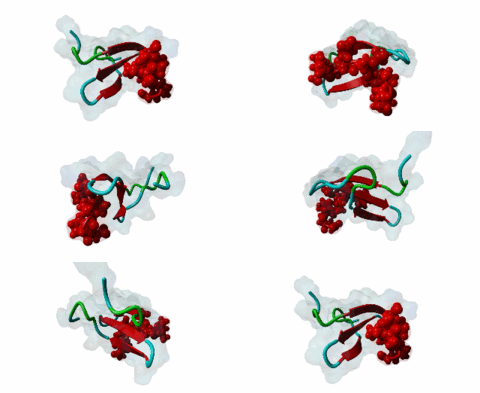
WW (PF00397)
WW domain
(Stochiometry: 1 : 1)
|
 Abstract Abstract |
WW are small modular domains of 38-40 residues long that mediate protein-protein interaction through binding of short proline-containing peptides that are typically in regions of native disordered polypeptide. WW are named after a pair of tryptophan residues that are important for structure-function. WW domains can occur singly or in clusters of up to four, as in the ubiquitin ligase Nedd4. WW domain-containing proteins are involved in many cellular processes such as ubiquitin-mediated protein degradation and mitotic regulation and they are also implicated directly or indirectly in several human diseases such as muscular distrophy and Alzheimer's and Huntington's diseases. Based on their ligand specificities, the WW domains have been divided into four classes. Group I WW domains bind proteins containing the PPXY motif, while group II recognize the PPLP motif. Group III recognise PPR motifs. There may be some overlap between the group II and III specificities. Group IV recognition is of p(ST)P sites and is dependent on phosphorylation by proline-directed kinases. The peptidyl-prolyl cis/trans isomerases (PPIase) are evolutionarily conserved enzymes that catalyse the cis/trans isomerization of peptidyl-prolyl peptide bonds. Pin1 is a unique PPIase that recognizes only the phosphorylated S/T motif preceding a proline residue. It is a multidomain protein contains a WW domain and PPIase domain and both domains work together to target the p(S/T)P sequence. Pin1 acts a mitotic regulator by catalyzing the isomerization of p(S/T)P motifs present in a defined subset of mitosis-specific phosphoproteins and also plays essential roles in transcription, DNA damage response, neuronal survival etc. The consequence of Pin1-mediated isomerization varies in individual substrates and phosphorylation sites which make them amenable to different processes like dephosphorylation, protein degradation, cleavage and targeting to different sub cellular localization etc. It is also found that the aberrant function of pin1 is linked to many diseases like cancer, AD, asthma, ageing and microbial infection and thus it represents a major therapeutic target. |
15 selected references:
11 GO-Terms:
96 Instances for DOC_WW_Pin1_4
(click table headers for sorting; Notes column: =Number of Switches, =Number of Interactions)
Please cite:
ELM-the Eukaryotic Linear Motif resource-2024 update.
(PMID:37962385)
ELM data can be downloaded & distributed for non-commercial use according to the ELM Software License Agreement
ELM data can be downloaded & distributed for non-commercial use according to the ELM Software License Agreement