
LIG_TPR
| Accession: | |
|---|---|
| Functional site class: | TPR binding site |
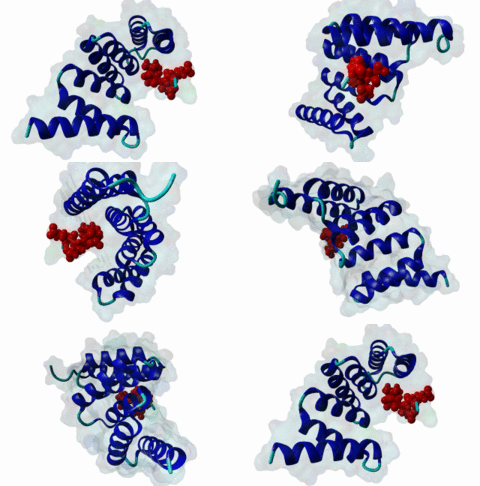
| Functional site description: | The C-terminal sequence EEVD, which is highly conserved in Hsp70 and Hsp90 protein, bind to the TPR domains. |
| ELM Description: | Ligands of the TPR (tetratricopeptide repeat motif) domains are EEVD motifs, C-terminal sequences highly conserved in all eukaryotic members of the Hsp70 and Hsp90 families. |
| Pattern: | EEVD$ |
| Pattern Probability: | 3.227e-08 |
| Present in taxon: | Eukaryota |
| Interaction Domain: |
TPR_1 (PF00515)
Tetratricopeptide repeat
(Stochiometry: 1 : 1)
|
 Abstract Abstract |
Heat shock proteins (HSPs), also called stress proteins, are a group of proteins that are present in all cells in all life forms. They are induced when a cell undergoes various types of environmental stresses like heat, cold and oxygen deprivation. HSPs are also present in cells under perfectly normal conditions. They act like 'chaperones,' regulating the folding and the conformational regulation of a variety of signal transduction proteins and cell cycle regulators in the eukaryotic cytosol. To achieve the folding of proteins such as steroid hormone receptors and protein kinases, Hsp90 and Hsp70 cooperate with numerous cofactors containing so-called tetratricopeptide repeat (TPR)1 domains. TPR domains are composed of loosely conserved 34-amino acid sequence motifs that are repeated several times per domain. The TPR co-factors of the Hsp70/Hsp90 multi-chaperone system interact with the C-terminal domains of Hsp70 and Hsp90. Deletion mutagenesis suggested that the C-terminal sequence motif EEVD-COOH, which is highly conserved in all Hsp70s and Hsp90s, has an important role in TPR-mediated cofactor binding. |
3 selected references:
-
Specific interaction of the 70-kDa heat shock cognate protein with the
tetratricopeptide repeats.
Liu FH, Wu SJ, Hu SM, Hsiao CD, Wang C
J Biol Chem 1999 Nov 26; 274 (48), 34425-32
PMID: 10567422
-
Structure of TPR domain-peptide complexes: critical elements in the
assembly of the Hsp70-Hsp90 multichaperone machine.
Scheufler C, Brinker A, Bourenkov G, Pegoraro S, Moroder L, Bartunik H, Hartl FU, Moarefi I
Cell 2000 Apr 14; 101 (2), 199-210
PMID: 10786835
-
Ligand discrimination by TPR domains. Relevance and selectivity of
EEVD-recognition in Hsp70 x Hop x Hsp90 complexes.
Brinker A, Scheufler C, Von Der Mulbe F, Fleckenstein B, Herrmann C, Jung G, Moarefi I, Hartl FU
J Biol Chem 2002 May 31; 277 (22), 19265-75
PMID: 11877417
6 GO-Terms:
9 Instances for LIG_TPR
(click table headers for sorting; Notes column: =Number of Switches, =Number of Interactions)
| Acc., Gene-, Name | Start | End | Subsequence | Logic | #Ev. | Organism | Notes |
|---|---|---|---|---|---|---|---|
| P54652 HSPA2 HSP72_HUMAN |
636 | 639 | GGSGGGGSGASGGPTIEEVD | TP | 4 | Homo sapiens (Human) | |
| Q90474 hsp90a.1 H90A1_DANRE |
722 | 725 | EEDMPVLEGDDDTSRMEEVD | TP | 2 | Danio rerio (Zebrafish) | |
| P17156 Hspa2 HSP72_MOUSE |
630 | 633 | YQGGPGGGGSSGGPTIEEVD | TP | 2 | Mus musculus (House mouse) | |
| P34931 HSPA1L HS71L_HUMAN |
638 | 641 | CGTGYVPGRPATGPTIEEVD | TP | 1 | Homo sapiens (Human) | |
| P07901 Hsp90aa1 HS90A_MOUSE |
730 | 733 | TEEMPPLEGDDDTSRMEEVD | TP | 1 | Mus musculus (House mouse) | |
| P07900 HSP90AA1 HS90A_HUMAN |
729 | 732 | TEEMPPLEGDDDTSRMEEVD | TP | 4 | Homo sapiens (Human) | |
| Q8INI8 Hsp70Ba HSP72_DROME |
638 | 641 | CGQQAGGFGGYSGPTVEEVD | TP | 1 | Drosophila melanogaster (Fruit fly) | |
| Q04967 HSPA6 HSP76_PIG |
640 | 643 | CGAQARQGAPSTGPVIEEVD | TP | 1 | Sus scrofa (Pig) | |
| P14659 Hspa2 HSP72_RAT |
630 | 633 | YQGGPGGGGSSGGPTIEEVD | TP | 2 | Rattus norvegicus (Norway rat) |
Please cite:
ELM-the Eukaryotic Linear Motif resource-2024 update.
(PMID:37962385)
ELM data can be downloaded & distributed for non-commercial use according to the ELM Software License Agreement
ELM data can be downloaded & distributed for non-commercial use according to the ELM Software License Agreement