
LIG_FAT_LD_1
| Accession: | |
|---|---|
| Functional site class: | Paxillin LD motifs |
| Functional site description: | The paxillin LD motifs are recognized by proteins mainly involved in cytoskeleton reorganization at adhesion foci. |
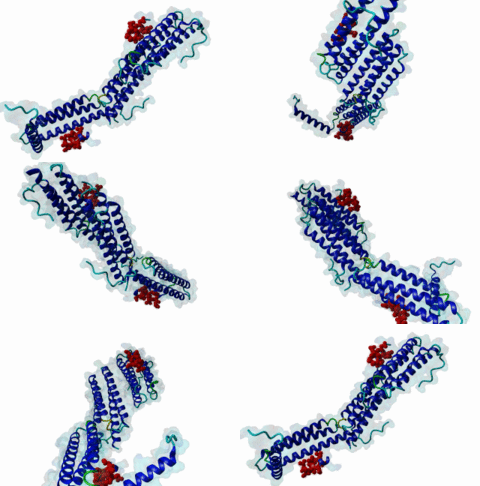
| ELM Description: | The paxillin LD motif binds as an amphipathic helical peptide to the FAT domain in FAK and PYK2. Since these LD regions bind to other cytoskeletal/focal adhesion proteins, it is not clear to what extent the motif pattern is specified by the FAT domain interaction. It is possible that, if there are peptide motifs that only bind FAT domains, the motif conservation of the hydrophobic positions would be looser. However, the conserved negatively charged residue is clearly a FAT domain specificity determinant. Prolines are excluded from the helical positions that are otherwise unconserved and solvent exposed in the solved complexes. |
| Pattern: | [LV][DE][^P][LM][LM][^P][^P]L[^P] |
| Pattern Probability: | 0.0000069 |
| Present in taxon: | Eukaryota |
| Interaction Domain: |
Focal_AT (PF03623)
Focal adhesion targeting region
(Stochiometry: 1 : 1)
|
 Abstract Abstract |
The paxillin LD motif was first found in the sequence of the protein paxillin and is named after a conserved Leu-Pro residue pair. Paxillin and its paralogues Leupaxin and TGFB1i1 are adaptor proteins that localize to the cytosolic side of focal adhesion complexes. Paxillin is a protein involved in integrin-mediated signalling for cell adhesion, motility and growth-factor inputs. It possesses five copies of the LD motif, short peptide sequences that bind as alpha-helices to the FAT domain of FAK and PYK2 kinases. Some of these repeat motifs also bind to FAT-like domains in Vinculin and GIT1 as well as to proteins with clearly different folds including the CH domain of alpha-parvin. Thus LD motifs appear to be part of complex multiway switching systems affecting cell state via the adhesion complexes. They can be targets for viral interference as has been reported for the BPV E6 protein. The LD motif entry in ELM is based on the FAK and PYK2 FAT domain interactions. As more data accumulates, it may be desirable to define overlapping motifs for the other helical interactions made by the LD regions of the paxillin family proteins. |
3 selected references:
-
Paxillin LD motifs may define a new family of protein recognition domains.
Brown MC, Curtis MS, Turner CE
Nat Struct Biol 1998 Aug; 5 (8), 677-8
PMID: 9699628
-
The paxillin LD motifs.
Tumbarello DA, Brown MC, Turner CE
FEBS Lett 2002 Feb 20; 513 (1), 114-8
PMID: 11911889
-
Paxillin comes of age.
Deakin NO, Turner CE
J Cell Sci 2008 Aug 1; 121, 2435-44
PMID: 18650496
9 GO-Terms:
4 Instances for LIG_FAT_LD_1
(click table headers for sorting; Notes column: =Number of Switches, =Number of Interactions)
| Acc., Gene-, Name | Start | End | Subsequence | Logic | #Ev. | Organism | Notes |
|---|---|---|---|---|---|---|---|
| P49023 PXN PAXI_HUMAN |
4 | 12 | MDDLDALLADLESTTSHISK | TP | 20 | Homo sapiens (Human) | |
| O43294 TGFB1I1 TGFI1_HUMAN |
158 | 166 | SATLELDRLMASLSDFRVQN | TP | 2 | Homo sapiens (Human) | |
| P49024 PXN PAXI_CHICK |
145 | 153 | SNLSELDRLLLELNAVQHNP | TP | 1 | Gallus gallus (Chicken) | |
| P49023 PXN PAXI_HUMAN |
266 | 274 | SATRELDELMASLSDFKIQG | TP | 2 | Homo sapiens (Human) |
Please cite:
ELM-the Eukaryotic Linear Motif resource-2024 update.
(PMID:37962385)
ELM data can be downloaded & distributed for non-commercial use according to the ELM Software License Agreement
ELM data can be downloaded & distributed for non-commercial use according to the ELM Software License Agreement