
TRG_LysEnd_GGAAcLL_1
| Accession: | |
|---|---|
| Functional site class: | Trans-Golgi Network-Endosome-Lysosome-sorting signals |
| Functional site description: | DxxLL acidic dileucine motifs act as sorting signals between the trans-Golgi network (TGN) and the endosomal-lysosomal compartment. Generally found near the protein C-terminus, they interact with GGA proteins which in turn can recruit clathrin. |
| ELMs with same func. site: | TRG_LysEnd_GGAAcLL_1 TRG_LysEnd_GGAAcLL_2 |
| ELM Description: | Sorting signal located at the C-terminus of type I transmembrane proteins from the Trans Golgi Network (TGN) targeted to the lysosomal-endosomal compartment. It interacts with the VHS domain of GGAs adaptor proteins, allowing the incorporation of cargo receptors and their cargo into clathrin coated vesicles budding from the TGN. Phosphorylation of a Serine residue upstream of the motif by casein kinase 2 could regulate the recognition of the motif at the TGN. It has been demonstrated that for the cation dependent mannose 6-phosphate receptor, phosphorylation of this Ser enhances the binding of the signal to its recognition module, the VHS domain of GGAs, by creating an additional point of attcahment to it (Kato,2002). |
| Pattern: | D..LL.{1,2}$ |
| Pattern Probability: | 9.585e-07 |
| Present in taxons: | Bos taurus Coelomata Gallus gallus Homo sapiens Mus musculus Rattus norvegicus Xenopus laevis |
| Interaction Domain: |
VHS (PF00790)
VHS domain
(Stochiometry: 1 : 1)
|
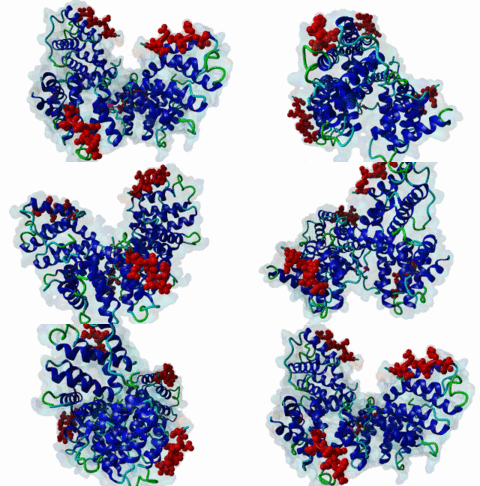
 Abstract Abstract |
Lysosomes are acidic compartments within cells where lumenal hydrolases degrade endogenous and internalized macromolecules. Most soluble hydrolases transit by the Trans Golgi network (TGN) where they are sorted from secretory proteins before they are directed to the endosome and then the lysosomes. The trans Golgi network is a major site of membrane protein sorting. The sorting events at the TGN involve transmembrane receptors bearing sorting determinants in their cytoplasmic tails. The interaction of such sorting signals with adaptor proteins such as the GGAs (Golgi-localized, gamma ear-containing, ARF-binding protein) is responsible for the targeting of the receptors (and therefore their cargo). DxxLL acidic diLeucine signals interact with the VHS domains of the GGA adaptor proteins which in turn can bind to clathrin and ARF factor (regulator of coat assembly at the TGN). GGAs act by recruiting the receptors into TGN-derived clathrin-coated vesicles for transport to endosomes. Further sorting to lysosomes or the cell surface may then occur. The DxxLL acidic diLeucine motifs interacting with GGAs have a very strong preference for Asp at the +1 position. This is in contrast to the acidic diLeucine motifs which bind to the sigma subunit of Adaptin-containing Adapter Protein (AP) complexes also involved in clathrin mediated vesicular transport: The AP complexes have a preference for Glu in the ExxLL acidic dileucine motifs (TRG_DiLeu_BaEn_1). |
5 selected references:
-
The dileucine motif within the tail of MPR46 is required for sorting of
the receptor in endosomes.
Tikkanen R, Obermuller S, Denzer K, Pungitore R, Geuze HJ, von Figura K, Honing S
Traffic 2000 Aug; 1 (8), 631-40
PMID: 11208151
-
Intracellular cycling of lysosomal enzyme receptors: cytoplasmic tails'
tales.
Dell'Angelica EC, Payne GS
Cell 2001 Aug 24; 106 (4), 395-8
PMID: 11525725
-
Structural basis for acidic-cluster-dileucine sorting-signal recognition
by VHS domains.
Misra S, Puertollano R, Kato Y, Bonifacino JS, Hurley JH
Nature 2002 Feb 21; 415 (6874), 933-7
PMID: 11859375
-
Structural basis for recognition of acidic-cluster dileucine sequence by
GGA1.
Shiba T, Takatsu H, Nogi T, Matsugaki N, Kawasaki M, Igarashi N, Suzuki M, Kato R, Earnest T, Nakayama K, Wakatsuki S
Nature 2002 Feb 21; 415 (6874), 937-41
PMID: 11859376
-
Phosphoregulation of sorting signal-VHS domain interactions by a direct
electrostatic mechanism.
Kato Y, Misra S, Puertollano R, Hurley JH, Bonifacino JS
Nat Struct Biol 2002 Jul; 9 (7), 532-6
PMID: 12032548
6 GO-Terms:
6 Instances for TRG_LysEnd_GGAAcLL_1
(click table headers for sorting; Notes column: =Number of Switches, =Number of Interactions)
| Acc., Gene-, Name | Start | End | Subsequence | Logic | #Ev. | Organism | Notes |
|---|---|---|---|---|---|---|---|
| P11717 IGF2R MPRI_HUMAN |
2485 | 2491 | VSSTKLVSFHDDSDEDLLHI | TP | 8 | Homo sapiens (Human) | |
| P08169 IGF2R MPRI_BOVIN |
2493 | 2499 | AAATPISTFHDDSDEDLLHV | TP | 1 | Bos taurus (Cattle) | |
| O75074 LRP3 LRP3_HUMAN |
764 | 770 | PPPPCSPMLEASDDEALLVC | TP | 2 | Homo sapiens (Human) | |
| Q99523 SORT1 SORT_HUMAN |
826 | 831 | TASHTNKSGYHDDSDEDLLE | TP | 4 | Homo sapiens (Human) | |
| P11456 M6PR MPRD_BOVIN |
273 | 279 | VGDDQLGEESEERDDHLLPM | TP | 3 | Bos taurus (Cattle) | |
| P20645 M6PR MPRD_HUMAN |
271 | 277 | VGDDQLGEESEERDDHLLPM | TP | 11 | Homo sapiens (Human) |
Please cite:
ELM-the Eukaryotic Linear Motif resource-2024 update.
(PMID:37962385)
ELM data can be downloaded & distributed for non-commercial use according to the ELM Software License Agreement
ELM data can be downloaded & distributed for non-commercial use according to the ELM Software License Agreement