
TRG_AP2beta_CARGO_1
| Accession: | |
|---|---|
| Functional site class: | AP-2 beta2 appendage CCV component motifs |
| Functional site description: | Several motifs are responsible for the binding of accessory endocytic proteins to the beta2-subunit appendage of the adaptor protein complex AP-2 as part of their recruitment to the site of clathrin coated vesicle (CCV) formation. Proteins binding the platform subdomain have been found to be cargo family specific (for example can load all GPCRs, or all LDL receptor family members) clathrin adaptors. Accessory proteins which help in CCV formation bind the sandwich subdomain site or the alpha ear domain. |
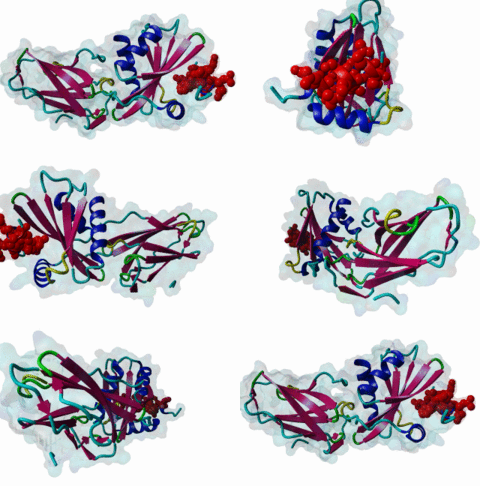
| ELM Description: | Motif binding as a helix in a depression on the top surface of the AP-2 beta appendage platform subdomain. The pattern [ED]x(1,2)Fxx[FL]xxxR is conserved in beta Arrestins, ARH and Epsin-1, -2 of vertebrates. It is also found in homologues of other metazoans, but the pattern is sometimes not matched exactly, meaning that the ELM regular expression will not provide a match. In other lineages, if there is an equivalent motif, the pattern is likely to have diverged. |
| Pattern: | [DE].{1,2}F[^P][^P][FL][^P][^P][^P]R |
| Pattern Probability: | 0.0000182 |
| Present in taxon: | Metazoa |
| Interaction Domain: |
B2-adapt-app_C (PF09066)
Beta2-adaptin appendage, C-terminal sub-domain
(Stochiometry: 1 : 1)
|
 Abstract Abstract |
At least two different surfaces of the AP-2 beta2 appendage domain can bind linear motifs in other endocytic regulatory proteins. The platform subdomain or top surface binds a helical [ED]x(1,2)Fxx[FL]xxxR motif found in Epsin-1 and -2 which bind ubiquitinated growth factor receptors, the beta-arrestins which bind GPCRs and ARH which binds LDL receptor family members. All of these function as cargo-selective clathrin adaptors, targeting surface receptors for internalization by clathrin-mediated endocytosis. In beta-arrestin, the cargo motif is regulated by a remarkable structural rearrangement. The motif maintains the endocytosis-incompetent state by binding back on the folded core of the protein in a beta strand conformation. Apparently triggered via a beta-arrestin/GPCR interaction, the motif must be displaced and must undergo a strand to helix transition to enable the beta2 appendage binding step that drives GPCR-beta-arrestin complexes into clathrin coats. The sandwich subdomain or side surface site binds an FxxxFxDF motif found in EPS15 and AP180 and may also accept other endocytosis proteins with variant motifs, as suggested by mutagenesis of the binding surface. The sandwich domain binders are accessory endocytic proteins (without a direct role in cargo binding) which help in CCV formation. Currently, there is no entry for the sandwich domain motif in ELM. |
4 selected references:
-
Functional dissection of an AP-2 beta2 appendage-binding sequence within
the autosomal recessive hypercholesterolemia protein.
Mishra SK, Keyel PA, Edeling MA, Dupin AL, Owen DJ, Traub LM
J Biol Chem 2005 May 13; 280 (19), 19270-80
PMID: 15728179
-
Molecular switches involving the AP-2 beta2 appendage regulate endocytic
cargo selection and clathrin coat assembly.
Edeling MA, Mishra SK, Keyel PA, Steinhauser AL, Collins BM, Roth R, Heuser JE, Owen DJ, Traub LM
Dev Cell 2006 Mar; 10 (3), 329-42
PMID: 16516836
-
Role of the AP2 beta-appendage hub in recruiting partners for
clathrin-coated vesicle assembly.
Schmid EM, Ford MG, Burtey A, Praefcke GJ, Peak-Chew SY, Mills IG, Benmerah A, McMahon HT
PLoS Biol 2006 Sep; 4 (9), e262
PMID: 16903783
-
Decoding ubiquitin sorting signals for clathrin-dependent endocytosis by
CLASPs.
Traub LM, Lukacs GL
J Cell Sci 2007 Feb 15; 120, 543-53
PMID: 17287393
7 GO-Terms:
4 Instances for TRG_AP2beta_CARGO_1
(click table headers for sorting; Notes column: =Number of Switches, =Number of Interactions)
| Acc., Gene-, Name | Start | End | Subsequence | Logic | #Ev. | Organism | Notes |
|---|---|---|---|---|---|---|---|
| Q9Y6I3 EPN1 EPN1_HUMAN |
402 | 411 | FDTEPDEFSDFDRLRTALPT | TP | 5 | Homo sapiens (Human) | |
| O95208 EPN2 EPN2_HUMAN |
456 | 465 | NGTIKDDFSEFDNLRTSKKT | TP | 0 | Homo sapiens (Human) | |
| Q5SW96 LDLRAP1 ARH_HUMAN |
256 | 266 | DDGLDEAFSRLAQSRTNPQV | TP | 2 | Homo sapiens (Human) | |
| P49407 ARRB1 ARRB1_HUMAN |
385 | 395 | TNDDDIVFEDFARQRLKGMK | TP | 6 | Homo sapiens (Human) |
Please cite:
ELM-the Eukaryotic Linear Motif resource-2024 update.
(PMID:37962385)
ELM data can be downloaded & distributed for non-commercial use according to the ELM Software License Agreement
ELM data can be downloaded & distributed for non-commercial use according to the ELM Software License Agreement