
LIG_CAP-Gly_1
| Accession: | |
|---|---|
| Functional site class: | CAP-Gly Domain Ligands |
| Functional site description: | CAP-Gly domains are central to the regulatory interactions at the plus ends of microtubules. They are found in a number of microtubule-interacting proteins with very diverse architectures. CAP-Gly domains harboring an intact GKNDG binding site motif recognise C-terminal EEY/F$ or WxxGCY$ C-terminal motifs of EB proteins, alpha-tubulin, CLIP-170 and SLAINs. In the case of alpha-tubulin, the terminal tyrosine residue is subject to a cycle of detyrosination-tyrosination. |
| ELMs with same func. site: | LIG_CAP-Gly_1 LIG_CAP-Gly_2 |
| ELM Description: | Short, acidic and aromatic carboxy terminal sequence found in a small group of microtubule-associated-proteins. The EEY/F$ motif is highly conserved and so far limited to a few known proteins, alpha-tubulin, EB proteins and CLIP170. The current regular expression is mainly modelled on the metazoan sequences. While there is the possibility that the motif has drifted in other lineages, it retrieves almost all alpha-tubulins in Swiss-Prot. It has a low but finite rate of false positives. |
| Pattern: | [ED].{0,2}[ED].{0,2}[EDQ].{0,1}[YF]$ |
| Pattern Probability: | 0.0000040 |
| Present in taxon: | Eukaryota |
| Interaction Domain: |
CAP_GLY (PF01302)
CAP-Gly domain
(Stochiometry: 1 : 1)
|
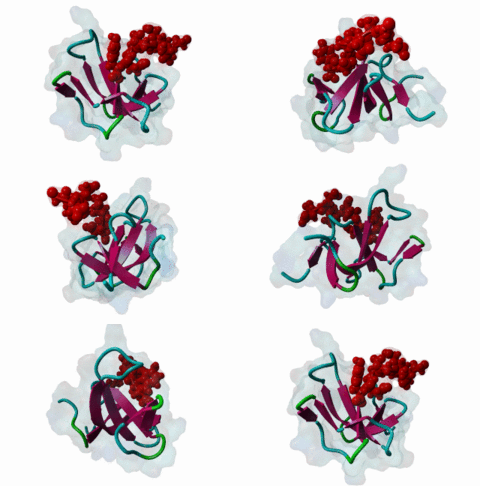
 Abstract Abstract |
The cytoskeleton-associated protein-glycine-rich domain (CAP-Gly; PF01302) is a small, approximately 80-residue protein module conserved in organisms from yeast to human. CAP-Gly domains have central functions in many proteins, including cytoplasmic linker proteins (CLIPs and CLIPRs), the large subunit of the dynactin complex (DCTN1, or p150glued), tubulin folding cofactors B and E, centrosome-associated protein-350 (CAP350), the kinesin protein KIF13b and the familial cylindromatosis tumor suppressor CYLD. These proteins are implicated in essential cellular processes such as chromosome segregation, establishment and maintenance of cell polarity, intracellular organelle and vesicle transport, cell migration, intracellular signaling and oncogenesis. The CAP-Gly domains of microtubule-associated-proteins (MAPs) are characterized by the conserved GKNDG motif, which is responsible for targeting to the carboxy terminal EEY/F sequence motifs of CLIP-170, EB proteins, and alpha-tubulin. In addition to recognizing the terminal tyrosine the the CAP-Gly domains of CLIPs can also specifically recognize the preceding tryptophan residue of the C-terminal WxxGCY sequence motif of SLAINs. The CAP-Gly EEY/F interaction is essential for the recruitment of the dynactin complex by CLIP170 (through p150glued) and for activation of CLIP-170. Furthermore, in most eukaryotic cells, the EEY/F tail of alpha-tubulin is subjected to an enzymatic detyrosination-tyrosination cycle in which the C-terminal tyrosine is repeatedly cleaved and added back. Suppression of this cycle leads to defects in spindle positioning, abnormal cell morphology, disorganized neuronal networks and tumour progression, underscoring the importance of this post-translational modification. Alpha-tubulin tyrosination has been linked to the ability of the microtubule plus end to recruit the CAP-Gly proteins p150glued, CLIP-170 and CLIP-115. Thus, the CAP-Gly-EEY/F interaction plays a fundamental role in the tubulin detyrosination-tyrosination cycle by controlling CAP-Gly proteins and as a consequence microtubule function. |
10 selected references:
-
Crystal structure of the cytoskeleton-associated protein glycine-rich
(CAP-Gly) domain.
Li S, Finley J, Liu ZJ, Qiu SH, Chen H, Luan CH, Carson M, Tsao J, Johnson D, Lin G, Zhao J, Thomas W, Nagy LA, Sha B, DeLucas LJ, Wang BC, Luo M
J Biol Chem 2002 Dec 13; 277 (50), 48596-601
PMID: 12221106
-
CLIP-170 interacts with dynactin complex and the APC-binding protein EB1
by different mechanisms.
Goodson HV, Skube SB, Stalder R, Valetti C, Kreis TE, Morrison EE, Schroer TA
Cell Motil Cytoskeleton 2003 Jul; 55 (3), 156-73
PMID: 12789661
-
Conformational changes in CLIP-170 regulate its binding to microtubules
and dynactin localization.
Lansbergen G, Komarova Y, Modesti M, Wyman C, Hoogenraad CC, Goodson HV, Lemaitre RP, Drechsel DN, van Munster E, Gadella TW Jr, Grosveld F, Galjart N, Borisy GG, Akhmanova A
J Cell Biol 2004 Sep 27; 166 (7), 1003-14
PMID: 15381688
-
CLIPs and CLASPs and cellular dynamics.
Galjart N
Nat Rev Mol Cell Biol 2005 Jun; 6 (6), 487-98
PMID: 15928712
-
Structural basis for the activation of microtubule assembly by the EB1 and
p150Glued complex.
Hayashi I, Wilde A, Mal TK, Ikura M
Mol Cell 2005 Aug 19; 19 (4), 449-60
PMID: 16109370
-
EB1 and EB3 control CLIP dissociation from the ends of growing
microtubules.
Komarova Y, Lansbergen G, Galjart N, Grosveld F, Borisy GG, Akhmanova A
Mol Biol Cell 2005 Nov; 16 (11), 5334-45
PMID: 16148041
-
Key interaction modes of dynamic +TIP networks.
Honnappa S, Okhrimenko O, Jaussi R, Jawhari H, Jelesarov I, Winkler FK, Steinmetz MO
Mol Cell 2006 Sep 1; 23 (5), 663-71
PMID: 16949363
-
Tubulin tyrosination is a major factor affecting the recruitment of
CAP-Gly proteins at microtubule plus ends.
Peris L, Thery M, Faure J, Saoudi Y, Lafanechere L, Chilton JK, Gordon-Weeks P, Galjart N, Bornens M, Wordeman L, Wehland J, Andrieux A, Job D
J Cell Biol 2006 Sep 11; 174 (6), 839-49
PMID: 16954346
-
CLIP170 autoinhibition mimics intermolecular interactions with p150Glued
or EB1.
Hayashi I, Plevin MJ, Ikura M
Nat Struct Mol Biol 2007 Oct; 14 (10), 980-1
PMID: 17828275
-
Structure-function relationship of CAP-Gly domains.
Weisbrich A, Honnappa S, Jaussi R, Okhrimenko O, Frey D, Jelesarov I, Akhmanova A, Steinmetz MO
Nat Struct Mol Biol 2007 Oct; 14 (10), 959-67
PMID: 17828277
11 GO-Terms:
3 Instances for LIG_CAP-Gly_1
(click table headers for sorting; Notes column: =Number of Switches, =Number of Interactions)
| Acc., Gene-, Name | Start | End | Subsequence | Logic | #Ev. | Organism | Notes |
|---|---|---|---|---|---|---|---|
| Q15691 MAPRE1 MARE1_HUMAN |
263 | 268 | TDEGFVIPDEGGPQEEQEEY | TP | 7 | Homo sapiens (Human) | |
| P30622 CLIP1 CLIP1_HUMAN |
1434 | 1438 | CEICEMFGHWATNCNDDETF | TP | 5 | Homo sapiens (Human) | |
| Q71U36 TUBA1A TBA1A_HUMAN |
443 | 451 | YEEVGVDSVEGEGEEEGEEY | TP | 4 | Homo sapiens (Human) |
Please cite:
ELM-the Eukaryotic Linear Motif resource-2024 update.
(PMID:37962385)
ELM data can be downloaded & distributed for non-commercial use according to the ELM Software License Agreement
ELM data can be downloaded & distributed for non-commercial use according to the ELM Software License Agreement