
| Accession: | |
|---|---|
| Functional site class: | Actin-binding motifs |
| Functional site description: | The function of actin in the cell is regulated in a variety of ways, including interactions with the RPEL motifs and WH2 motifs, which bind to actin's hydrophobic cleft formed by its subdomains 1 and 3. RPEL motifs, unstructured in solution, form two helices linked by a loop upon binding. They are known to sequester MRTF transcription factors in the cytosol. RPEL-containing proteins have been found in metazoans, as well as in fungi. WH2 motifs are present in many eukaryotic organisms, including metazoa, plants and fungi. The structure of the motif comprises a short N-terminal helix of a variable length followed by an irregular region. It acts via interactions with G-actin, thus promoting or inhibiting the filament assembly. In some proteins WH2 motifs are also involved in regulation of the filament nucleation process. The differences in the functioning of various WH2-containing proteins may result from motif variants, which in several cases are not fully consistent with the assumed conservation pattern. |
| ELMs with same func. site: | LIG_Actin_RPEL_3 LIG_Actin_WH2_1 LIG_Actin_WH2_2 |
| ELM Description: | WH2 is a bipartite motif consisting of a short alpha-helix at its N-terminus followed by a disordered region. The most important amino acids determining the motif's ability to interact with actin are leucine and lysine (often substituted by arginine) in positions -4 and -3 from the motif C-terminus, respectively. The N-terminal helix is rich in hydrophobic amino acids enabling it to fit into the cleft formed by actin's subdomains 1 and 3. The helix contains a fragment of variable length (4-7 residues) that enables another helix turn to be included. It is followed by a loop, comprising the critical leucine and lysine/arginine residues interacting directly with the actin molecule. In several cases the C-terminal region is longer and contains residues forming a conserved pattern .T.[DE]...P which is putatively stabilizing WH2- actin interactions. This extension of the motif, not included in the ELM regular expression occurs in beta-thymosins, a group of proteins composed of WH2 domains only. For proper functioning they require an additional K/R residue at the C-terminus. They also contain a phenylalanine in position -5, conserved exclusively within this protein family. However, the level of conservation in these positions is too low to consider them an integral part of the motif. The WH2 motif is present in many proteins in various eukaryotes. It is possible to find several sequence variants, which differ from the assumed conservation pattern. In some proteins there are single cases of e.g. K/R substituted by T or N, yet their role and putative impact on actin binding remains unclear. WH2 motifs were divided into two groups. In this version positions 1 and 3 are not precisely defined, as many variants are found in different proteins. Despite lower level of conservation, this group of the WH2 motifs appears to demonstrate equally high actin-binding affinity. |
| Pattern: | [^R]..((.[ILMVF])|([ILMVF].))[^P][^P][ILVM].{4,7}L(([KR].)|(NK))[VATIGS] |
| Pattern Probability: | 0.0006603 |
| Present in taxon: | Eukaryota |
| Interaction Domain: |
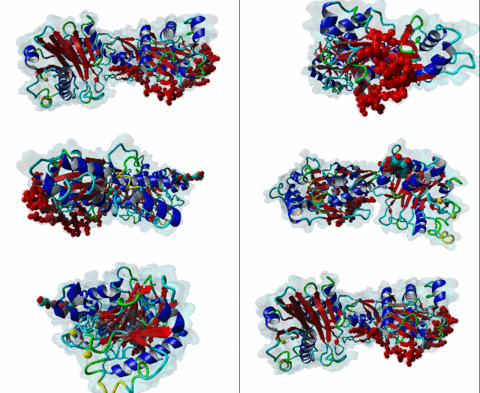
Actin (PF00022)
Actin
(Stochiometry: 1 : 1)
|
 Abstract Abstract |
Actin is a core structural component of the cytoskeleton, which owing to its ability to contract, polymerize and interact with a wide range of proteins influences many cellular functions such as the control of cell shape, motility, and polarity, as well as cellular transport. Both formation of filaments, and actin's action as a molecular switch can be regulated by a variety of factors, including interactions with specific motifs, which mediate actin-protein interactions by binding to actin's hydrophobic cleft formed by subdomains 1 and 3. RPEL motifs and WH2 motifs are present in a wide range of proteins and bind actin monomers in a hydrophobic cleft. Although the invariant amino acids that are essential to binding vary (arginine in RPEL and leucine in WH2, respectively), both motifs have a preference for peripheral hydrophobic amino acids (mostly leucines and isoleucines) to stabilize the interactions. The RPEL motif is unstructured in solution and forms two helices linked by a short loop upon actin binding. The WH2 motif forms a short helix followed by an irregular region, which stabilizes upon actin binding. In both cases the residues essential for binding lie within the unstructured loop. The function of RPEL motifs was best characterized in MRTF-A and MRTF-B proteins known to interact with serum response factor transcription factor and thus activate the transcription. There, RPEL-mediated G-actin binding (regulated by Rho-signalling controlled actin polymerization) causes the protein's retention in the cytoplasm by blocking the NLS and thus prevents the formation of the MRTF-SRF transcription- activating complex. The WH2 motif, present in a variety of proteins, functions as a regulator of actin dynamics. In beta-thymosins and WASP, binding to actin inhibits its polymerization, while in ciboulot and the WAVE1/Scar family it promotes actin filament assembly. Furthermore, in WASP the WH2 motif also prevents actin filaments from spontaneous nucleation. The WH2 motifs were also found in the Phosphatase and actin regulator protein PHAR but there their function remains unclear. Although the sequences of the motifs are distinct, they bind in the same actin region (a cleft formed by subdomains 1 and 3). RPEL- and WH2- mediated actin- binding appears to be affecting a variety of significant cellular processes and seems to be essential for proper cell functioning. |
7 selected references:
6 GO-Terms:
17 Instances for LIG_Actin_WH2_2
(click table headers for sorting; Notes column: =Number of Switches, =Number of Interactions)
Please cite:
ELM-the Eukaryotic Linear Motif resource-2024 update.
(PMID:37962385)
ELM data can be downloaded & distributed for non-commercial use according to the ELM Software License Agreement
ELM data can be downloaded & distributed for non-commercial use according to the ELM Software License Agreement