
| Accession: | |
|---|---|
| Functional site class: | Sumoylation site |
| Functional site description: | Sumoylation is a common PTM of nuclear proteins that affects their functional status. SUMO belongs to the large multiprotein family of Ubiquitin-like proteins. The sumoylation modification is achieved by a typical E1-, E2- and E3-ligase based system. Many transcription factors, chromatin proteins and proteins involved in other nuclear functions as well as the nuclear pores are sumoylated. Sumoylation is known to cause dramatic rearrangements of the subnuclear location of modified proteins. |
| ELMs with same tags: | |
| ELMs with same func. site: | LIG_KEPE_1 LIG_KEPE_2 LIG_KEPE_3 MOD_SUMO_for_1 MOD_SUMO_rev_2 |
| ELM Description: | Motif recognised for modification by SUMO-1 |
| Pattern: | [VILMAFP](K).E |
| Pattern Probability: | 0.0019140 |
| Present in taxon: | Eukaryota |
| Interaction Domain: |
UQ_con (PF00179)
Ubiquitin-conjugating enzyme
(Stochiometry: 1 : 1)
|
 Abstract Abstract |
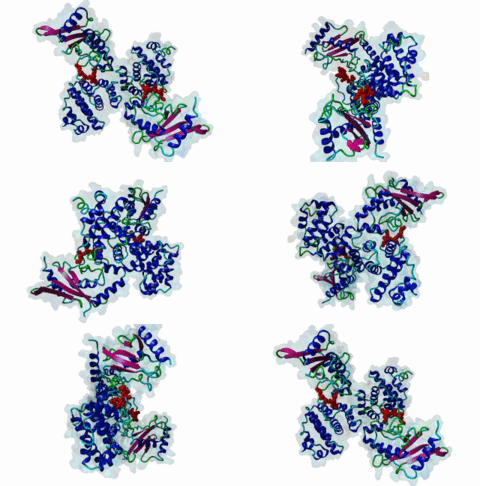
The SUMO proteins are Small Ubiquitin-related MOdifiers that are covalently conjugated onto lysine residues within target proteins (Tang,2008, Anckar,2007, Geiss-Friedlander,2007). Invertebrates have a single SUMO gene, whereas the SUMO family in vertebrates has three members; SUMO-1, SUMO-2, and SUMO-3. The SUMO proteins are synthesized as inactive precursors, which are processed by SUMO-specific carboxy-terminal hydrolases, resulting in novel double-glycine C-termini. The mature SUMO proteins are then activated by the Aos1/Uba2 activating enzyme (E1) and transferred to the Ubc9 conjugating enzyme (E2). Eventually, the SUMO protein is covalently linked to the target protein by the formation of an isopeptide bond between the carboxyl terminus of SUMO and an epsilon-amino group of a lysine residue of the target protein. The reaction is aided by an E3 ligase, e.g. mammalian PIAS1. This process, termed sumoylation, is reversible by certain SENP family desumoylating proteases. Most sumoylated proteins are nuclear, and three main functional roles of SUMO have been proposed. (i) Protein targeting: sumoylation has been shown to be important for nuclear import of the RanGAP1 protein, and for recruiting proteins to subnuclear protein complexes (e.g. promyelocytic leukemia protein (PML) to PML nuclear bodies). (ii) Enhancement of protein stability by potential competition with (and inhibition of) ubiquitination. (iii) Transcriptional control (e.g. negative regulation of transcription from the androgen receptor). A core motif (PhiKxE) has been identified as the sumoylation target for SUMO-1 (Endter,2001, Poukka,2000, Sternsdorf,1999). SUMO-2/3 themselves contain a PhiKxE site, in contrast to SUMO-1, and can thus form polymeric chains (shown in vitro, and in vivo for SUMO-2) (Tatham,2001). The Crystal structure of a complex between SUMO-1, E2 Ligase UBC9, E3 Ligase RanGAP1 and the target protein RanBP2 (3UIP, Gareau,2012) shows, that the hydrophobic residue (leucine) and glutamic acid bind to the E2 ligase UBC9 and stabilize lysine, which fits into the catalytic pocket of UBC9. The E3 ligase RanGAP1 binds SUMO-1 with a SIM (SUMO interacting motif) LIG_SUMO_SIM_par_1 motif and stabilizes the N-terminus of SUMO-1 which also fits into the catalytic pocket of UBC9 where the covalent binding of SUMO-1 to RanBP2 takes place. A number of reports in the literature suggest modified versions of the core motif (PhiKxE): (i) KEPE motif (LIG_KEPE_1, LIG_KEPE_2 and LIG_KEPE_3): A bioinformatics survey of nuclear proteins revealed a common extended SUMO site, termed the KEPE motif (Diella,2008) in transcriptional and chromatin proteins. The function of the KEPE motif remains to be determined. (ii) PDSM motif: A Phosphorylation-Dependent Sumo Motif (PhiKxExxSP) has been found (Hietakangas,2006) which consists of the core motif with a phosphorylation site. It was found to regulate sumoylation of the transcription regulators GATA-1, MEF2a and HFSs (Hietakangas,2006). (iii) NDSM motif: Another extended version of the core motif is the NDSM (Negatively charged amino acid-Dependent Sumoylation Motif), which has clusters of acidic residues downstream from the core motif (Yang,2006). These acidic clusters help to increase the efficiency of sumoylation, for example for the transcription factor ELK-1. Beside these modified versions of the core motif, multiple high throughput mass spectrometry studies (Matic,2010, Tammsalu,2014, Impens,2014, Hendriks,2014) have shown that an inverted version (E/DxK) of the motif is also used, but less commonly. Yung-Kang Lee et al. (Lee,2007) confirmed the inverted SUMOylation site in TRIM28 by a combination of proteomic screening and site- directed mutagenesis. These finding have also been confirmed by another study (Ivanov,2007). Currently there is no crystal structure of the inverted motif available. There are also some sumoylation sites that do not fit to either the canonical or the reverse motif. ELM annotators have noted that these seem to always be at sites in folded globular domains, raising the possibility that there is a structural motif at these sites, in contrast to the more typical short linear motifs. |
9 selected references:
8 GO-Terms:
46 Instances for MOD_SUMO_for_1
(click table headers for sorting; Notes column: =Number of Switches, =Number of Interactions)
Please cite:
ELM-the Eukaryotic Linear Motif resource-2024 update.
(PMID:37962385)
ELM data can be downloaded & distributed for non-commercial use according to the ELM Software License Agreement
ELM data can be downloaded & distributed for non-commercial use according to the ELM Software License Agreement