
LIG_EVH1_1
| Accession: | |
|---|---|
| Functional site class: | EVH1 ligands |
| Functional site description: | Proline-rich sequences that bind to the signal transduction modules EVH1. |
| ELMs with same func. site: | LIG_EVH1_1 LIG_EVH1_2 LIG_EVH1_3 |
| ELM Description: | Proline-rich motif binding to signal transduction class I EVH1 domains. |
| Pattern: | ([FYWL]P.PP)|([FYWL]PP[ALIVTFY]P) |
| Pattern Probability: | 0.0001237 |
| Present in taxons: | Caenorhabditis elegans Drosophila melanogaster Eumetazoa Gallus gallus Homo sapiens Mus musculus |
| Interaction Domain: |
WH1 (PF00568)
WH1 domain
(Stochiometry: 1 : 1)
|
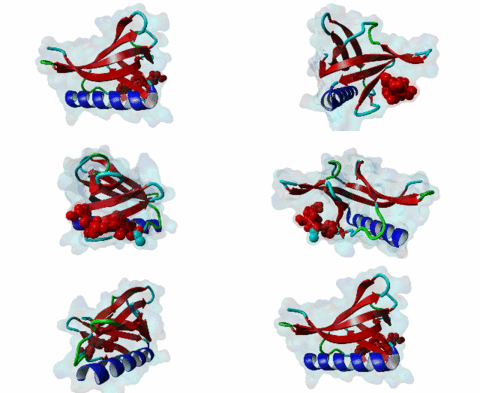
 Abstract Abstract |
Enabled/vasodilator-stimulated phosphoprotein homology 1 (EVH1) domains are 115 residue protein-protein interaction modules which provide essential links for their host proteins to various signal transduction pathways. Many EVH1-containing proteins are associated closely with actin-based structures and are involved in re-organization of the actin cytoskeleton. EVH1 domains are also present in proteins enriched in neuronal tissue, thus implicating them as potential mediators of synaptic plasticity, linking them to memory formation and learning. EVH1 domains recognize and bind specific proline-rich sequences (PRSs). In general, a small (3-6 residue) core PRS in the target protein binds a 'recognition pocket' on the domain surface. Further affinity- and specificity-increasing interactions are then formed between additional domain epitopes and peptide 'core-flanking' residues. The protein-protein interactions mediated by EVH1 domains are clearly highly important for the regulation of signal transduction events, re-organization of the actin cytoskeleton, and modulation of actin dynamics and actin-based motility. EVH1 domains can be divided into three classes based on the consensus sequences of their target PRS ligands. Single residue peptide substitution experiments have shown the consensus binding motif for class I EVH1 domains to be F-P-X-(hydrophobic)-P. Such sequences are found in a number of mammalian proteins, including the focal adhesion proteins zyxin and vinculin, as well as in the ActA protein of the intracellular pathogen Listeria monocytogenes. Class II EVH1 domains are found in the Homer-Vesl protein family of postsynaptic receptor associated proteins. These recognize a consensus PRS, with a core motif comprising PPxxF, found in the group I mGluRs, IP3Rs, RyRs and the Shank family proteins. The EVH1 domains exclusive for WASP and N-WASP proteins are also called WH1/ WASP-homology 1 domains. The EVH1 class III motifs are found in the verprolin family of proteins. They are known to play a role in WASP/N-WASP- mediated processes (e.g. regulation actin filament dynamics by WIP and WIRE), yet their exact functions remain to be elucidated. The recognition motif of EVH1 class III includes a polyproline region, which is a common feature of all EVH1 motifs, yet in class III it comprises an additional region which contains two highly conserved phenylalanines. |
7 selected references:
-
Structure of the enabled/VASP homology 1 domain-peptide complex: a key
component in the spatial control of actin assembly.
Prehoda KE, Lee DJ, Lim WA
Cell 1999 May 14; 97 (4), 471-80
PMID: 10338211
-
Structure of EVH1, a novel proline-rich ligand-binding module involved in
cytoskeletal dynamics and neural function.
Fedorov AA, Fedorov E, Gertler F, Almo SC
Nat Struct Biol 1999 Jul; 6 (7), 661-5
PMID: 10404224
-
Dual epitope recognition by the VASP EVH1 domain modulates polyproline
ligand specificity and binding affinity.
Ball LJ, Kuhne R, Hoffmann B, Hafner A, Schmieder P, Volkmer-Engert R, Hof M, Wahl M, Schneider-Mergener J, Walter U, Oschkinat H, Jarchau T
EMBO J 2000 Sep 15; 19 (18), 4903-14
PMID: 10990454
-
The N-terminal domain of Homer/Vesl is a new class II EVH1 domain.
Barzik M, Carl UD, Schubert WD, Frank R, Wehland J, Heinz DW
J Mol Biol 2001 May 25; 309 (1), 155-69
PMID: 11491285
-
Doing (F/L)PPPPs: EVH1 domains and their proline-rich partners in cell
polarity and migration.
Renfranz PJ, Beckerle MC
Curr Opin Cell Biol 2002 Feb; 14 (1), 88-103
PMID: 11792550
-
EVH1 domains: structure, function and interactions.
Ball LJ, Jarchau T, Oschkinat H, Walter U
FEBS Lett 2002 Feb 20; 513 (1), 45-52
PMID: 11911879
-
An EVH1/WH1 domain as a key actor in TGFbeta signalling.
Callebaut I
FEBS Lett 2002 May 22; 519 (1), 178-80
PMID: 12023040
10 GO-Terms:
19 Instances for LIG_EVH1_1
(click table headers for sorting; Notes column: =Number of Switches, =Number of Interactions)
Please cite:
ELM-the Eukaryotic Linear Motif resource-2024 update.
(PMID:37962385)
ELM data can be downloaded & distributed for non-commercial use according to the ELM Software License Agreement
ELM data can be downloaded & distributed for non-commercial use according to the ELM Software License Agreement